
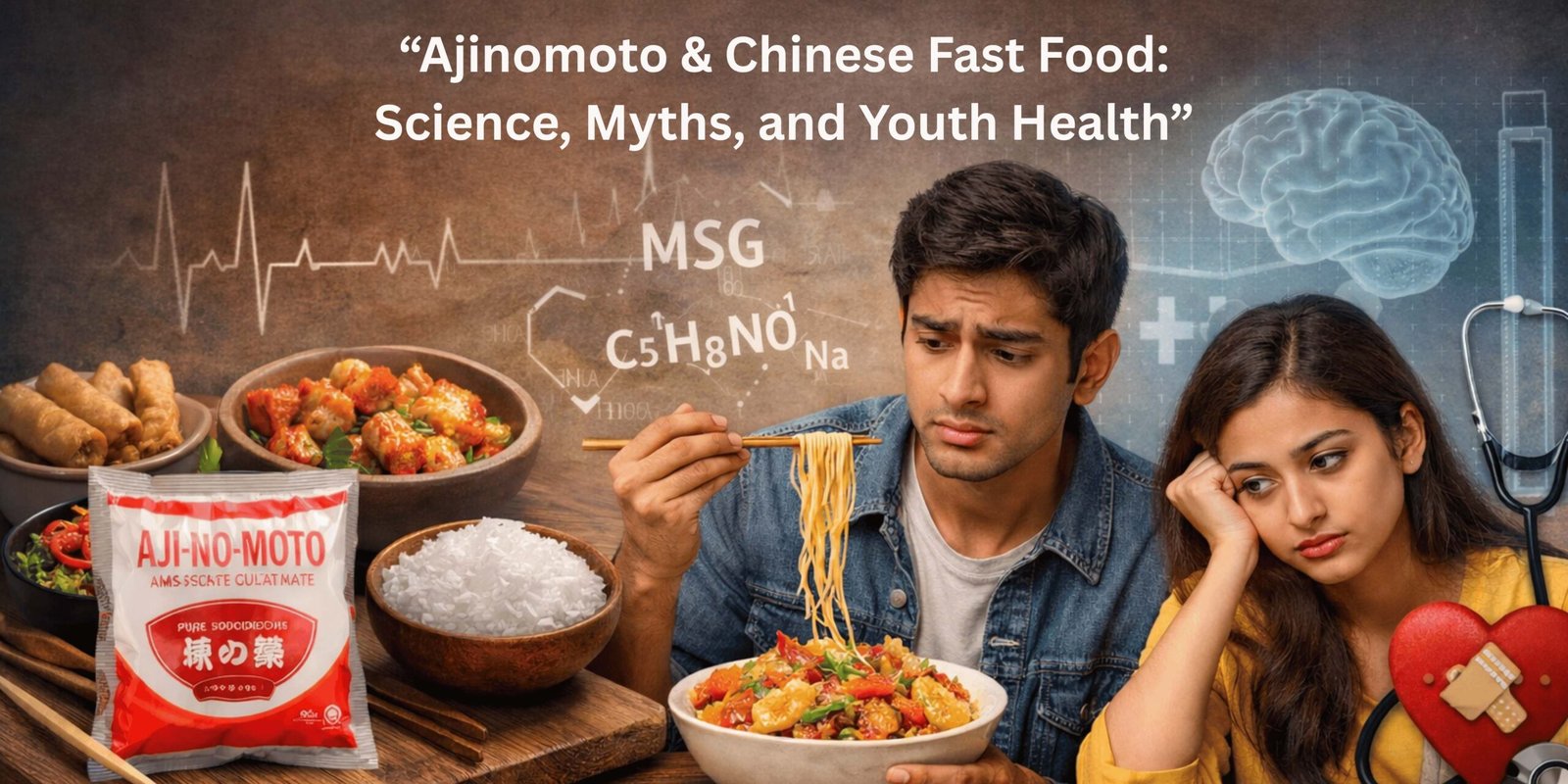
Ajinomoto: Walk into any street corner today and you’ll find it:
steaming noodles, sizzling Manchurian, fried momos — and a long queue of young people.
The flavors are addictive, the prices are low, and the tag line is simple:
“Fast, tasty, cool.”
But behind that irresistible taste lies something most people don’t think about — Ajinomoto, commonly known as MSG (monosodium glutamate).
So, what is Ajinomoto really doing to our food — and to our habits?
Is it dangerous, or misunderstood? And why do many spiritual traditions — including Jain teachings — quietly warn against such foods?
Let’s look at the truth, through science and wisdom together.
Ajinomoto: What exactly is Ajinomoto (MSG)?
MSG, or monosodium glutamate, is a flavor enhancer.
It boosts umami — that deep, savory taste we find tempting.
It’s found naturally in tomatoes, cheese, mushrooms and soy sauce.
But in fast food, it is added in concentrated form to make even ordinary food feel irresistible.
How is Ajinomoto made?
- It starts with plants like sugarcane, corn, or cassava.
- Friendly bacteria ferment the plant sugars, turning them into glutamic acid.
- The glutamic acid is purified, combined with sodium, and crystallized into the white granules called MSG.
So, while MSG is similar to what’s naturally in food, it is much more concentrated in fast food.
This is why Chinese-style dishes often feel:
- Extra savory
- Extra satisfying
- And hard to stop eating
MSG itself, in moderate quantities, is considered safe by many food authorities. But here’s the part people ignore:
How Ajinomoto (MSG) Changes Taste and Cravings
It tricks the brain into thinking the food is more delicious than it actually is.
So we crave more. We overeat. And we slowly get addicted to flavors instead of nutrition.
That’s where the real danger begins.
Ajinomoto & the Brain–Food Connection
Studies show that Ajinomoto can increase the release of dopamine — the feel-good chemical linked to reward.
Temporary pleasure.
But no real nourishment.
Combine that with:
- Deep-fried oil
- High salt
- Refined flour
- Zero fiber
and you have a perfect recipe for long-term problems, especially for young bodies:
- Weight gain
- Fatigue
- Headaches in some sensitive people
- Higher blood pressure
- Disturbed digestion and sleep
- Junk-food dependence instead of real meals
The issue is not only MSG.
It is the whole package of ultra-processed “fast Chinese” food.
Why Occasional Chinese Food Can Become Harmful
Occasional eating doesn’t destroy health overnight.
But habits do.
Street-style Chinese becomes dangerous when it becomes:
- After-school snack
- College time hangout food
- Daily dinner substitute
- Comfort food when stressed
Because slowly, we train our tongue to love artificial taste
and forget the natural taste of fruits, grains, vegetables, nuts, and home-cooked food.
That is where both science and spirituality meet.
The Jain Perspective: Ajinomoto-Free and Mindful Eating
In Jain philosophy, food isn’t just fuel — it is character building.
Three core ideas stand out:
- Ahimsa (non-violence) — eating with minimum harm and exploitation
- Aparigraha (simplicity) — avoiding excess and unnecessary craving
- Satvikta (purity) — food that keeps the mind calm and conscious
Chinese-style junk food is the opposite of all three:
- Encourages over-consumption
- Disconnects us from mindful eating
- Often includes ingredients harmful to health and sometimes animal-derived sauces
Jain elders say:
“Jaisa khana, waisa man.”
(As is your food, so becomes your mind.)
When food is heavy, artificial and addictive —
the mind slowly becomes restless, impatient, craving-driven.
And youth deserve better than that.
Science Meets Jain Wisdom: Making Better Choices
Modern research tells us:
- Whole foods protect heart, brain and gut
- Plant-based diets reduce chronic diseases
- Natural flavors keep our taste buds balanced
Eat what nourishes you, not what controls you.
Practical Tips to Reduce Ajinomoto in Your Diet
Here’s how youth can transition — without feeling deprived:
- Choose fresh snacks- Fruit bowls, sprouts, roasted chana, peanuts, dry fruits, homemade sandwiches.
- Cook your own “healthier Chinese”- Use vegetables, minimal salt, ginger-garlic, herbs — skip Ajinomoto.
- Read food labels- Avoid packets that say “MSG, flavor enhancers, E-621, taste makers.”
- Eat when hungry — not bored- Listen to your body, not your cravings.
- Remember your purpose- Health, clarity, strength — not just taste.
A Thought to Carry Forward
Youth is energy. Youth is potential.
But energy thrives only when the body is honest — and the mind is calm.
Ajinomoto may make meals louder in taste —
but silence inside the body is far more precious.
Let’s choose food that:
- Respects our health
- Respects self-control
- Respects compassion
- Aligns with the wisdom our elders quietly followed
Real strength is in choosing what truly supports your life.
Final Word
This is not fear.
This is awareness.
Ajinomoto (MSG) is not “poison” —
but the culture built around junk Chinese eating habits is undeniably harmful.
And the sooner youth understand this,
the more powerful, conscious and purposeful their future becomes.
Eat simple, clean and with awareness.
Also Read: https://jinspirex.com/eat-before-sunset-the-science-your-body-loves/