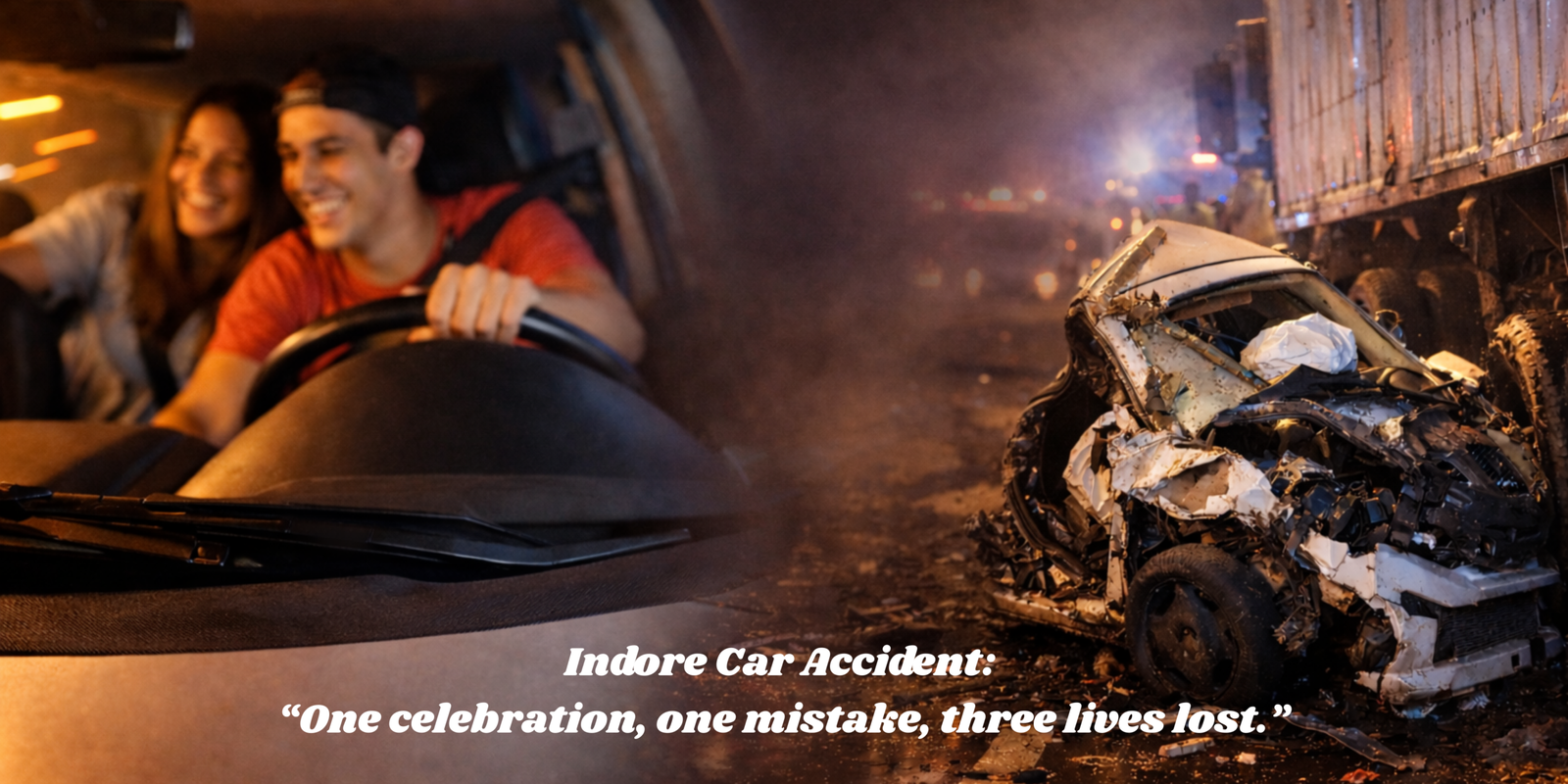
Indore Car Accident: One birthday celebration. One late-night drive. One moment of lost control. Three young lives gone forever.
Road accidents no longer shock us.
They scroll past our screens like just another news update.
But sometimes, an incident forces us to stop — not because of who was involved, but because it could have been any of us.
The tragic accident in Indore is one such wake-up call for every young driver.
Indore Car Accident: The Background: What Happened in Indore?
In the early hours of Friday morning, a devastating road accident occurred on the Tejaji Nagar bypass highway in the Ralamandal area of Indore.
A speeding Tata Nexon car rammed head-on into a truck at around 5 am.
Three young people lost their lives on the spot:
- Prerna Bachchan (26)
- Prakhar Kasliwal (25)
- Maan Sandhu (26)
The fourth occupant, Anushka Rathi, was seriously injured and admitted to hospital.
Prerna was the daughter of Rajpur Congress MLA and former Madhya Pradesh home minister Bala Bachchan, while Prakhar was the son of Anand Kasliwal, the current state Congress spokesperson.
According to Tejaji Nagar police station in-charge Devendra Markam, the four friends had gone to a resort on the outskirts of Indore on Thursday night to celebrate Prakhar’s birthday.
While returning home, the car lost control and crashed into the truck. Police stated that Prakhar was driving and either fell asleep or was under the influence of alcohol.
The car was so badly mangled that a crane was required to remove it from the road.
Former Chief Minister Kamal Nath, Leader of Opposition Umang Singhar, and several leaders expressed grief.
But beyond politics, this was a youth tragedy — one that carries lessons too important to ignore.
https://jinspirex.com/madhya-pradesh-bhopal-26-ton-cow-meat-slaughterhouse-questions/
10 Things This Indore Accident Teaches Every Young Driver
1. Celebration Does Not Cancel Consequences
A Jain reminder: Karma doesn’t pause for happiness.
A birthday night. A resort. Friends together.
Nothing about that night suggested tragedy.
But accidents don’t wait for the “right” moment.
Fun does not make you immune to danger.
In Jain thought, every action creates a result — whether done in joy or carelessness. Celebration never cancels responsibility.
2. Alcohol Doesn’t Just Slow Reflexes — It Kills Judgment
Jain wisdom values awareness over intoxication.
Most young drivers don’t think they’re “too drunk to drive.”
They think they’re still in control.
Alcohol makes you:
- Overconfident
- Less alert
- Blind to fatigue
Jain teachings emphasise self-control (sanyam) — because a mind that loses awareness often causes maximum harm, to self and others.
One wrong decision can undo an entire lifetime.
3. Late-Night Driving Is More Dangerous Than You Think
Ignoring body limits is also a form of violence.
At 5 am, the body is tired even if the mind feels awake.
Fatigue + speed + intoxication = a deadly mix.
Jain philosophy teaches respect for the body as a vehicle of consciousness, not something to push until it breaks.
4. Speed Feels Powerful — Until It Takes Power Away Forever
Ego is louder than wisdom.
Youth often confuse speed with skill.
But no amount of confidence can fight:
- Sleep
- Alcohol
- Heavy vehicles
- One unexpected second
In Jain thought, ego (maan) is a major cause of downfall. Speed does not prove courage. It only reduces survival time.
5. Accidents Don’t Care About Surnames or Status
Karma treats everyone equally.
Powerful background. Political families. Influence.
None of it mattered at that moment.
Jainism reminds us: status disappears in one moment, but consequences remain. Roads treat everyone equally. Death does not check identity.
6. Friends Should Stop You — Not Cheer You
True friendship follows compassion, not crowd pressure.
True friendship is not:
- Laughing at risky driving
- Ignoring intoxication
- Saying “kuch nahi hoga”
Jain values promote anukampa (compassion) — protecting life, even if it means going against the group. Real friends protect lives, even if it ruins the vibe.
7. One Decision Can Turn Parents’ Lives Upside Down
Parents’ pain is unseen violence.
Youth often think about themselves.
But accidents destroy:
- Mothers who wait forever
- Fathers who lose their purpose
- Homes that fall silent
In Jain ethics, hurting others indirectly is also harm. Parents don’t recover from such losses — they only learn to live with pain.
8. Social Media Has Normalised Risk
But Jainism teaches mindfulness, not mindless imitation.
Fast cars. Stunts. Party reels. Late-night drives.
We see danger so often that it feels normal.
Jain philosophy encourages vivek (sense) — the ability to think before acting. Real life has no retake, no filter, no delete option.
9. Survival Is Not Luck — It’s Responsibility
Ahimsa begins with self-protection.
Accidents are not always destiny.
Many are:
- Preventable
- Predictable
- Avoidable
Choosing not to drive after drinking is not weakness — it is ahimsa in action, protecting your life and others.
10. Being Alive Is the Biggest Achievement
Life itself is the highest value.
No party is worth dying for.
No thrill is worth lifelong regret.
The real flex is:
- Reaching home safely
- Respecting your parents’ sacrifices
- Choosing life, every single time
Jain teachings remind us: life is rare, precious, and meant to be protected — not gambled.
Indore Car Accident: A Final Message to Young Drivers
“Speed. Alcohol. One careless moment — pause.”
Ask yourself just one question:
“If something happens to me tonight, what happens to my parents tomorrow?”
That answer is reason enough to slow down.