
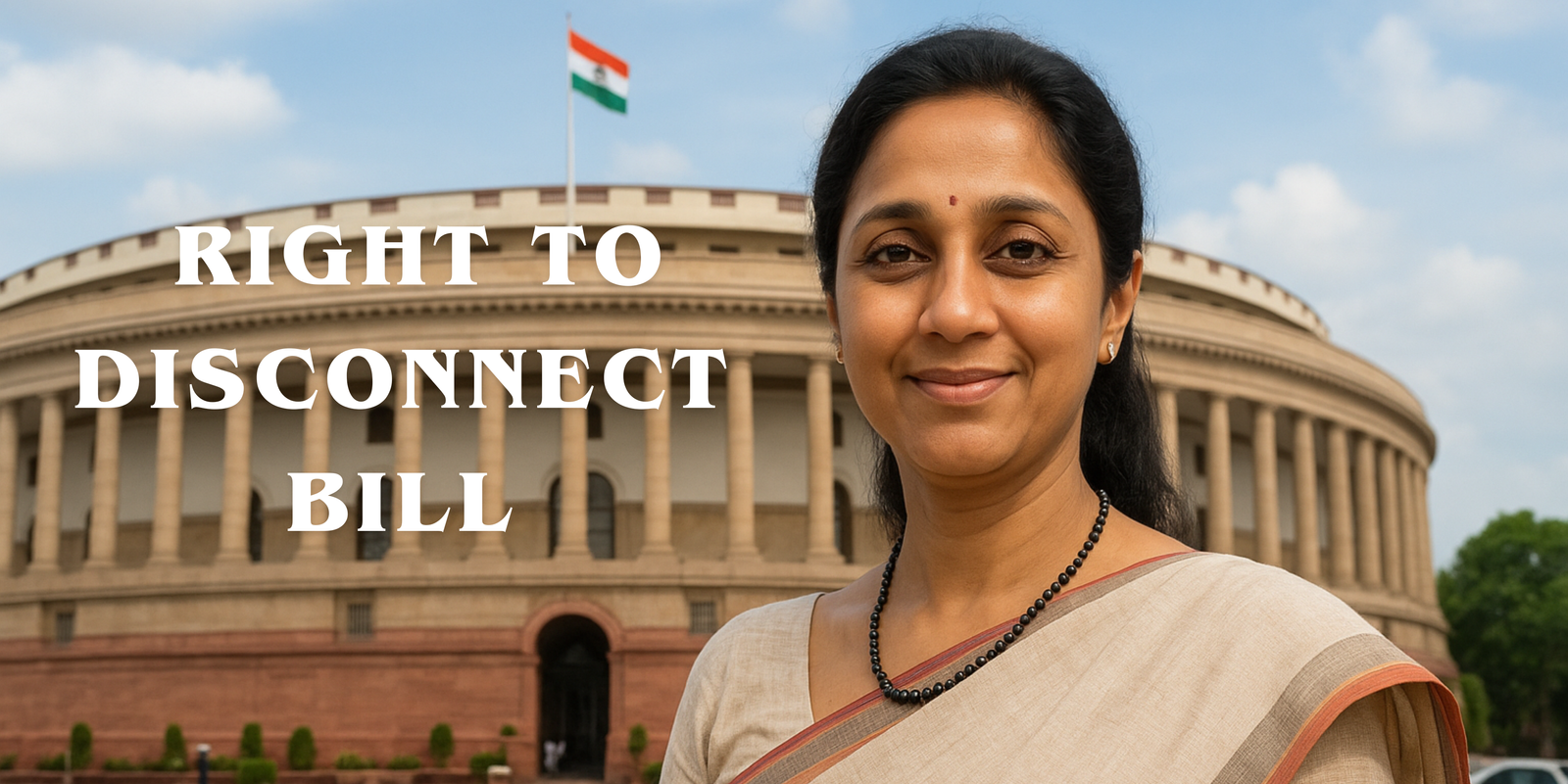
Right to Disconnect: In the last decade, the way we work has changed more than it changed in the previous fifty. Deadlines travelled from office desks to personal phones. Meetings shifted from conference halls to living rooms, and work blurred into evenings, weekends, holidays — sometimes even hospital rooms and funerals.
Then, suddenly, one idea resurfaced in India’s Parliament:
A Bill that says employees should not be expected to respond to work messages, emails, or calls after office hours.
This Right to Disconnect Bill, reintroduced recently as a Private Member’s Bill by MP Supriya Sule, has sparked an important question across the country:
Does a worker have the right to be unavailable?
And another question emerged right next to it:
What happens when such a law meets the culture of Work-From-Home — where flexibility is the selling point, but availability often becomes unlimited?
This article isn’t just analysis.
It’s a mirror.
A space to pause and ask:
Are we working — or are we constantly proving that we are working?
The Rise of the “Always-Available” Employee
Before COVID-19, “office hours” had shape and boundaries. You arrived at 10 AM, you left at 6 PM. Your availability had an end.
But the pandemic changed the working ecosystem. Work-From-Home brought convenience, yes — but it also created an invisible expectation:
If work comes home, availability does too.
Late-night emails became normal.
Weekend meetings were justified as “just a quick sync”.
WhatsApp messages replaced HR policy.
Somewhere in this transformation, work stopped being a part of life — and quietly became the center of it.
So, What Exactly Is the Right to Disconnect Bill?
The proposed bill seeks to:
- Protect employees’ personal time
- Make after-hours communication optional — not mandatory
- Require companies to define “urgent” vs. “non-urgent” communication
- Ensure no punishment for respecting boundaries
In simple words:
You can disconnect — without the fear of losing respect, bonus, or your job.
Sounds ideal, right? But reality is rarely that straightforward.
Where the Debate Begins: Can WFH and Right to Disconnect Co-Exist?
On paper, the Right to Disconnect empowers employees.
But here’s the counter-argument employers are raising:
“If employees want flexible hours, how can availability be fixed?”
“What about global teams across time zones?”
“What if there’s an urgent client call?”
These questions aren’t unreasonable — they highlight the complexity of modern work.
Work-From-Home is built on fluid timelines, autonomy, and trust.
Right to Disconnect introduces boundaries, structure, and legal accountability. So — are these ideas opposites?
Or do they complete each other?
Global Lessons: Does This Work Anywhere?
Many countries have already tried this idea:
- France — boundaries policy mandatory
- Portugal — fines for after-hours contact
- Ireland — Right to Disconnect included in work guidelines
- Spain & Belgium — after-hours compensation required
What did they learn?
Employees were less burnt out
Productivity improved
Job satisfaction increased
Companies adapted — and survived
None of these economies collapsed because employees stopped replying at 11:45 PM.
Instead, something else collapsed:
The belief that productivity = constant availability.
But India Is Different — Isn’t It?
Yes — uniquely so.
- Outsourcing and global client dependency
- Fast business cycles
- Hierarchical work culture
- Hustle glorified as loyalty
- Messaging apps treated like official platforms
India’s workforce is also young — ambitious, competitive, and often afraid of missed opportunities.
So the debate is not just legal or operational.
It is cultural.
Are employers ready to trust without supervising availability?
Are employees ready to say, “Not now — this is my personal time”?
The Human Cost: Why This Bill Exists
Burnout isn’t a buzzword — it’s becoming a lifestyle.
- Anxiety
- Sleep issues
- Digital exhaustion
- Weak attention span
- Broken work-life boundaries
- Reduced family presence
- Loss of identity beyond profession
When life shrinks and work expands, we stop being human beings — and become job roles.
Right to Disconnect is not just a regulation.
It’s a reminder:
People work — but people are not work.
A Lesson From Jain Philosophy: Balance Over Excess
Jainism teaches a timeless principle: Aparigraha — non-excess.
It doesn’t refer only to material possessions — it extends to thoughts, habits, time, and emotional boundaries.
Excess, even if disguised as ambition or efficiency, eventually becomes a burden.
Work, like everything meaningful, requires discipline — but also detachment.
A Jain teaching often said is:
“Work with commitment, not attachment.”
Meaning:
Give your best during your working hours —
but do not allow work to consume every space of your life.
If happiness, rest, relationships, silence, or identity disappear because of work — then success is costing too much.
A Future Possibility: Harmony, Not Conflict
What if this isn’t a battle?
What if Work-From-Home gives freedom,
and Right to Disconnect gives boundaries —
together shaping a healthier culture?
Flexible hours
Without constant visibility pressure
Remote freedom
Without loss of peace
Commitment to outcomes
Not commitment to endless availability
Maybe the future isn’t choosing sides.
Maybe the future is balance.
So Let’s Ask — Honestly, Not Legally
Should work end when office hours end?
Or does modern success require constant availability?
Should law define boundaries — or should culture evolve first?
Is disconnecting a right — or a privilege only some can afford?
https://www.hindustantimes.com/india-news/what-is-right-to-disconnect-bill-introduced-in-lok-sabha-and-can-it-clear-parliament-101765025582585.html
There may not be one universal answer —but there must be a collective discussion.
Final Thought
Work defines us — but it should not consume us.
Homes are not offices.
Evenings are not meetings.
And humans are not devices with “online” and “last seen” timestamps.
The question isn’t merely:
Does India need a Right to Disconnect?
The question is:
Are we finally ready to reclaim our time, identity, relationships, and well-being — without guilt?
So tell us —
What do you think?
Should India adopt this law?
Or is it unrealistic for our work culture?
Your voice matters —
because this future, in the end, belongs to the people living inside it.
Also Read: https://jinspirex.com/vitamin-b12-deficiency-include-moringa-in-your-diet-during-winters/